The Green Divide – a short story

This is a work of fiction. Names, characters, businesses, places, events and incidents are either the products of the author’s imagination or used in a fictitious manner. Any resemblance to actual persons, living or dead, or actual events is purely coincidental.

The Green Divide

By Dwayne MacEachern     © 2025

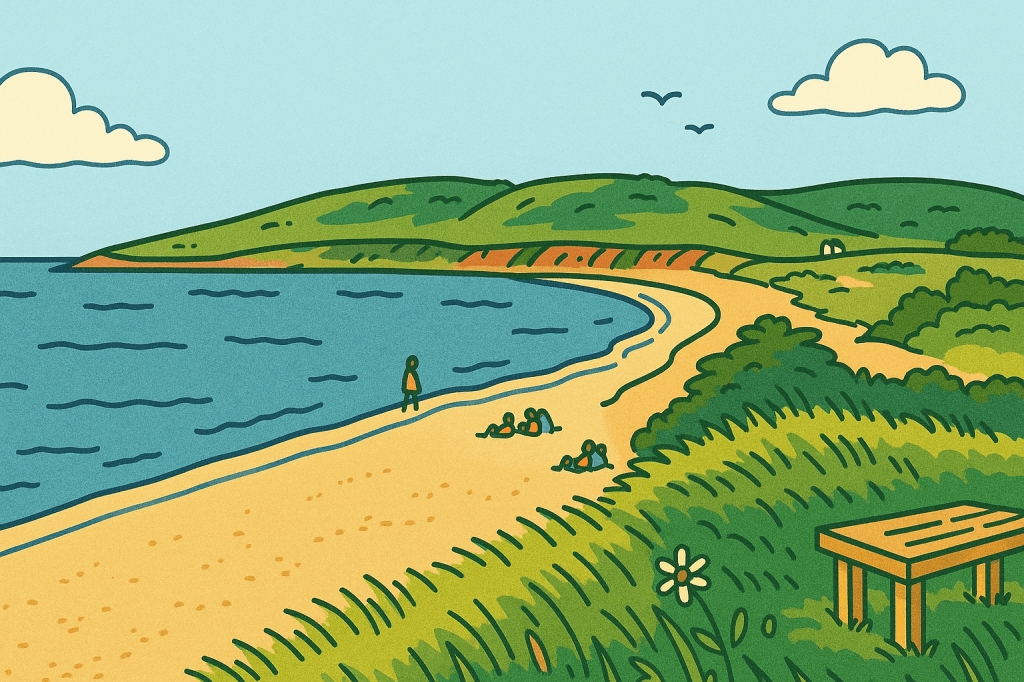
A gull screamed above the dunes, its wings catching the late-afternoon light like a flash of polished bone. The tide was out, and West Mabou Beach sprawled in wide bands of sea-glossed sand, shallow water shimmering like glass under a pale sun. The wind—cold, sharp, straight off the Gulf—rattled the faded wooden sign nailed to a post near the lot: Provincial Park – No Vehicles Beyond This Point.

Isla Beaton walked barefoot, boots tied and slung over one shoulder, pants rolled to her calves, a thick hoodie drawn up over her black hair. Her jeans were already crusted in dried salt from a creek she’d crossed upstream, chasing silence. No earbuds today. The beach didn’t need a soundtrack.

About a half kilometre down, near the low cliffs where dogwood tangled with spruce, she noticed them.

Two men. Not tourists.

One was hunched over a tripod-mounted instrument pointed inland, adjusting knobs with careful precision. The other stood off to the side with a clipboard, watching something invisible—marking, measuring. Surveyor types, maybe. But they didn’t look provincial.

They wore clean windbreakers, spotless boots. One had a Cape Golf-branded ballcap. The other’s truck—a black Yukon—was parked illegally just inside the old gate, beside the worn “No Motorized Access” sign. No one ever parked there, not in April.

She slowed.

The clipboard guy noticed her. Gave a small, two-finger wave. The other didn’t.

They didn’t call out. Didn’t offer an explanation. Just turned back to their instruments and notes.

She stared for a moment longer, then kept walking, past the curve of sand, past the tide pools filling slowly with sky.

Something itched in her chest. Not anger—yet—but something ancestral. Some whisper that this place, this crooked bay with its seaweed tang and rattling driftwood and old birdsong, didn’t belong to men with clipboards.

She’d ask her dad. He knew things. Even if he never wanted to talk about any of it.

The bell over the shop door gave its familiar defeated jingle as Isla stepped into Beaton & Son Hardware, even though the “& Son” part hadn’t been updated since before she was born. Her father stood behind the counter with a half-unwrapped roll of polyethylene under one arm and a calculator in his other hand.

He looked up. “Thought you were off communing with sea spirits.”

“I was,” Isla said, brushing sand off her knees. “Until I found guys creeping around the park.”

Callum’s hands didn’t stop moving. “What guys?”

“Two of them. Big Yukon parked right next to the no-vehicles sign. One had a Cape hat.”

That slowed him. He set the plastic roll down and leaned forward slightly.

“Cape?” he repeated.

She nodded, peeling off her hoodie. “They had a tripod. Measuring gear. Surveying, I think.”

He scratched his jaw, eyes drifting toward the window where the wind pressed dry leaves against the glass.

“Probably just developers sniffing around,” he muttered. “Happens every few years.”

“They were in the park, Dad. That’s protected land.”

Callum didn’t answer right away. He turned, fiddled with the receipt printer, then walked behind the counter to unplug the coffee machine. His silence was deliberate, practiced. Isla had seen it before—after the funeral, during COVID, whenever something big loomed.

She stepped closer. “Do you think it’s true? That they’re going to build another course?”

He gave a dry snort. “They already got two. Think they’ll stop now?”

She frowned. “This is different. It’s a park.”

“That never stopped anyone,” he said, too softly.

The silence that followed wasn’t comfortable.

“You’re not going to say anything?” she asked. “To anyone?”

Callum looked up at her, then past her, toward the front door where the wind now pushed harder, rattling the frame. The last light of day was slipping off the wet pavement.

He pulled the keys from his back pocket and started toward the entrance. “Not until I know what I’m talking about.”

She stood there as he turned the lock.

“Go wash your feet,” he said over his shoulder. “You’re tracking in half the beach.”

The kitchen smelled like haddock fried in too much butter. A green curtain danced over the open window, letting in sea air and a faint sour whiff of kelp. Callum moved slowly between stovetop and sink, bare feet heavy on the worn linoleum, his shoulders curved like a bridge under strain.

“Plate,” he said.

Isla passed him one. He scraped two filets onto it with a metal spatula, then slid it across the counter. “Fork’s in the drawer. Rice in the pot.”

She grabbed what she needed and sat. No one spoke for the first few minutes. They rarely did. The television in the living room murmured low—some panel of Toronto types arguing about pensions.

Outside, wind pulled at the siding.

“Why’d they make it a park?” Isla asked finally, between bites. “Do you remember?”

Callum didn’t look up. He was picking at the second filet with surgeon-like care. “Back in the nineties. Some folks petitioned. Environmental protection. That sort of thing.”

“Angus Campbell was part of that, right?”

“Probably. He’s been part of everything.”

She pushed her rice around the plate. “Do you think it matters? That it’s a provincial park?”

“I think,” he said slowly, “it matters to people who care. But not everyone does.”

She stared at him. “But legally. Doesn’t it stop them?”

Callum shrugged. “Depends who’s in charge.”

Isla exhaled sharply. “So they can just… undeclare it?”

“It’s not a magic spell, Isla. It’s politics. Cabinet decisions, mostly.”

She stood, suddenly restless, and paced to the window. A car passed outside, tires humming on damp pavement.

“I’m going to post about it,” she said. “That I saw them. That they were surveying.”

Callum didn’t move.

“I might start a petition,” she added. “Or at least ask around. People need to know.”

He set down his fork. “Careful.”

“Careful of what?”

“Starting fires you can’t put out.”

She turned. “You mean doing something?”

“I mean blowing up your whole world on the word of two guys with a tripod and a Cape hat.”

“They were in the park, Dad.”

Callum stood up slowly and took his plate to the sink. “And maybe they were just looking. Maybe it’s already a done deal. You don’t know.”

“But we can know. If people push—if we organize—”

“No,” he said firmly, turning to face her. “You push too fast, too loud, they’ll box you in, call you hysterical, and nobody listens. That’s how this works.”

The silence that followed wasn’t empty. It was electric.

“Sounds like fear,” she said, voice low.

Callum looked at her for a long moment.

“It is,” he said.

The folding chairs in Mabou Hall hadn’t been replaced since the sixties, and the heating system made a sound like a moose dying under a tarp. Still, people came. They always did when something threatened to change things.

By 6:45, the parking lot was packed—F-150s, rust-bitten Civics, a few battered Subarus. Isla sat near the front, notebook in her lap, scanning the crowd. She saw Angus Campbell near the back, arms crossed, cap low. Sadie MacNeil stood by the coffee urn, listening intently to Derek, who gestured with a half-eaten oatmeal cookie like it was a baton.

Her father sat on the far edge of the row behind her. Close enough to observe, far enough not to be implicated.

At exactly 7:00, the front doors opened again, and Graham Schizer entered like he owned the place.

He had the look of someone used to microphones—smooth blazer, tan complexion, steel-grey hair parted with a ruler. A Cape-branded folder in one hand. Not a scrap of paper out of place.

“Good evening,” he said, striding up to the mic stand. “What a pleasure to be back in Mabou.”

Some clapped. Some didn’t.

He smiled wide, revealing investment-grade teeth. “I know there’s been chatter. Rumours. Concerns. And I think it’s important we meet face-to-face, neighbour to neighbour, and talk about what’s really happening.”

Isla’s stomach twisted. She felt Callum’s presence behind her like a stone.

Graham flipped open his folder. “The Cape group is exploring the idea of a new, world-class course that would highlight the natural beauty of West Mabou. We believe golf can coexist with conservation—and enhance public access, not restrict it.”

Someone near the back coughed. Loudly.

Graham pressed on. “This is not a done deal. We’re early in the process. But we wanted to begin with consultation, transparency, and—above all—respect.”

Murmurs rippled through the crowd. Sadie raised her hand.

“Yes,” Graham said, pointing.

“If it’s not a done deal,” Sadie said, “why were there surveyors in the park last week?”

A pause. Just long enough.

“We routinely send folks to assess feasibility,” he said. “That doesn’t imply commitment. It’s just good planning.”

Isla stood.

“Who gave them permission to go into a protected park?”

Heads turned.

Graham smiled like he’d expected this. “The Department of Natural Resources was informed. We followed protocols.”

“What protocols?” Isla asked. “The ones where you get what you want because you’re rich?”

A few gasps. A few nods.

“I’d be happy to meet with you afterward,” Graham said smoothly. “There’s no need to make this personal.”

“It is personal,” came a voice from the back.

Angus Campbell stepped forward. His boots thudded on the old floor.

“That park belongs to the people of this province,” he said. “It’s not your brochure. It’s not your playground for men in slacks.”

Several clapped. Someone hissed.

“You paved Inverness and called it progress,” Angus continued. “Now you want to carve up another corner of coast. For what? So somebody from Dallas can post a picture of their lobster roll?”

Graham held up a hand. “Let’s be respectful—”

“Respect is earned,” Angus snapped.

The hall buzzed, loud now. Two men near the middle row stood up, one shaking his head, muttering, “This is why nobody invests in places like this.”

Callum still hadn’t moved.

Isla turned slightly, met his eyes—just for a moment.

He looked away.

The post hit Facebook before Isla even got home.

A shaky clip of Graham Schizer’s smug grin as he said, “Golf can enhance public access.” The audio was clear. The sarcasm in her caption was sharper:

Isn’t it so generous when billionaires offer to improve something they’re about to destroy? #WestMabouNotForSale

By morning, it had over 130 shares. By noon, it had a tag war in the comments—names Isla recognized from church, the school board, the meat counter at the Co-op.

Sadie MacNeil:

Folks, maybe let’s all take a breath. Nobody’s tearing anything down yet.

Derek MacIsaac (replying to Sadie):

Maybe YOU can afford to wait. Some of us need the work.

Rory Gillis:

So we sell our coast for what, six dishwashing jobs and a fresh layer of turf?

Nancy Campbell (Angus’s cousin):

My grandkids might finally be able to stay here if we had real jobs. Angus has his pension. What do the rest of us have?

By dinnertime, someone had created a second group:
“Mabou Deserves Better – Jobs and Progress”
Banner image: golfers smiling on the cliffs of Inverness.
Founding admin: Derek.


The café was louder than usual that afternoon. Not in sound—no one was talking—but in tension.

Sadie moved like someone carrying a full glass of water over ice. Three tables had customers who hadn’t looked up once. One regular—Mrs. Rankin, who always left a tip in exact change—sat with her arms folded, eyes locked on her untouched muffin.

When Isla walked in, conversation died completely.

Sadie greeted her anyway. “Want your usual?”

Isla hesitated. “You still talking to me?”

Sadie smiled thinly. “I talk to everybody. It’s my job.”

She poured a coffee, set it down with practiced ease.

“I saw the comments,” she added.

“I meant what I said.”

“I know you did.”

They stood in silence.

Then, quietly, Sadie asked, “Can I tell you something without you posting about it?”

Isla nodded.

“There’s good people who support the course,” Sadie said. “That doesn’t make them evil.”

“Doesn’t make them right either.”

Sadie leaned in, eyes tired. “You think I want this? I’m still paying off my CEBA loan. I haven’t hired anyone full-time in three years. What am I supposed to do—fight the only people bringing money in?”

“Maybe.”

Sadie looked down, then smiled softly. “You sound like your mother.”

The words hit like salt on a fresh scrape.

Isla picked up her coffee, gave a nod, and left.

At the hardware store, Callum saw it too. A change. People still came in, but the small talk died. Neighbours who once spent ten minutes chatting over paint chips now left with mumbled thanks.

Two men nearly argued over propane fittings.

One asked if Callum was “part of that protest nonsense his daughter was stirring up.”

He didn’t answer. Just rang them through and kept his head down.

That night, Angus stopped by, just before close.

He bought rope and gloves. Refused a bag.

“Hell of a speech you didn’t give,” Angus muttered.

Callum paused. “Wasn’t my place.”

“Your girl’s doing what you should’ve.”

Then he left without saying goodbye.


The BMW was spotless except for the plastic grocery bag squatting dead center on the hood. It had been tied twice, but not tightly. Enough to keep the shape. Enough to suggest deliberate placement.

Schizer stood in the gravel driveway with his phone held high, angling for the best shot.

Close-up. Then wide.

In the background, his rented bungalow sat bland and neutral. A polite little executive getaway two kilometres outside Port Hood, tastefully staged with “Live, Laugh, Love” beach signs and a bowl of decorative rope on the table.

His caption read:

“I believe in dialogue. In conversation. In building better futures. But this is what some in Mabou think passes for debate. Disgusting, cowardly, and sad. #WeCanDoBetter”

Then he carefully, with gloves on, removed the bag of dog shit from his car and into a thicker garbage bag and brought it to the box at the end of the driveway.

Within an hour, his post was retweeted dozens of time, including by a cabinet minister.


At 4:17 that same afternoon, the Province of Nova Scotia issued a four-sentence news release:

Effective immediately, the status of West Mabou Beach Provincial Park is being re-evaluated under the Parks and Protected Areas Plan. The area will be reclassified to allow for alternative recreational development in alignment with regional economic goals. Further consultations will be announced in due course.

No press conference.
No Q&A.
No mention of golf.

The media barely noticed. Halifax was mid-scandal with a ferry tender gone sideways.

But in Mabou, someone printed the release and taped it to the Co-op freezer with a butcher knife.


The café was full when the news hit.

Sadie read it on her phone behind the counter and froze mid-pour. Across the room, Derek was nodding along with a man in a golf windbreaker—someone no one quite recognized.

Angus walked in five minutes later, holding the printed release like it was a death notice.

He slammed it on the counter. “That’s it.”

Sadie looked up, stunned. “You’re sure?”

“It’s over. They’ve got what they wanted.”

A man at the back stood. “You don’t know that.”

Angus spun to face him. “Are you blind or just stupid?”

Derek stood too. “Angus—”

“Don’t talk to me.”

“Then don’t talk at me.”

“Thirty years ago we protected that beach,” Angus growled. “We marched for it. Lobbied. Met with the ministers. I was there. You were still in your father’s skidoo trailer.”

People stopped eating.

Sadie moved to the front. “Okay. Enough.”

“I’ve got enough,” Angus snapped. “Enough lies. Enough deals made in f—”

Something crashed.

A chair.

Thrown. No one saw by who.

It hit the linoleum and bounced with a thud and scrape and fell flat.

Silence. Breathless.

Sadie’s face drained.

Callum was outside when it happened. He’d come to return a propane tank someone had left at the shop.

He heard the sound through the wall. Watched as Angus stormed out, shoulders shaking, eyes raw.

Isla followed seconds later, clutching her phone.

“Did you see it?” she asked.

Callum nodded.

“Do something,” she whispered.

He opened his mouth.

But said nothing.


The fences came fast.

One day the dirt access road to the beach was muddy and half-eaten by ruts, and the next, it was ringed with bright orange mesh and two new “NO TRESPASSING – SITE PREPARATION UNDERWAY” signs, hammered into the earth like exclamation marks.

Then came the posts—tall, grey, driven deep. Steel fencing was fastened along the top of the dunes in sections, curving around the western path that locals used to take from the tree line. A new gravel lot was being shaped out of what used to be a wildflower meadow.

And just beyond it all, at the edge of the beach, parked on the gravel: a white pickup with a vinyl security badge across the door and a man sitting behind the wheel eating a ham sandwich.


Isla was there before school.

She’d biked the seven kilometres from Mabou with gloves on, teeth chattering, camera bag strapped to her back. When she reached the fence line, she got off and walked slowly to the gate. It was chained shut.

The metal was cold beneath her fingers.

She could see the sea, still there, endless, laughing at the notion of gates. But now the sand was fenced. The old driftwood log she and her mom used to sit on was gone—probably bulldozed with the stunted trees.

She stood there, not moving, for a long time.

Then her father’s truck pulled up.

He got out slowly, as if preparing for weather.

She didn’t look at him.

Callum walked to her side, hands in his coat pockets.

For a few seconds, they stood in silence, the fence between them and the life they remembered.

Then she said, “They said we’d always have access.”

Callum didn’t reply.

“They promised.”

“Marketing always sounds like promises,” he said quietly.

She turned to him, eyes red. “This is my place.”

He nodded.

She shook her head. “You just let it happen.”

“I didn’t let it—”

“You didn’t stop it,” she snapped. “You watched it happen. You stood there while Schizer lied, while people yelled, while the signs came down, while—” Her voice cracked.

“I’m not the one building the course, Isla.”

“But you’re the one who could’ve said something when it still mattered.”

He inhaled sharply. “I didn’t want to lose this town.”

“We lost it anyway,” she said.

That stopped him.

The wind picked up. The fence creaked. Out beyond it, gulls wheeled and screamed over the water like they’d always done.

She looked back at the beach once more, then stepped away from the gate.

When she walked past him, she didn’t look up.

He didn’t stop her.

______________________________________________________________________________

The sky hadn’t yet figured out what it wanted—half silver, half gunmetal, with the moon still clinging to the western horizon when Isla dropped her bike behind a salt-blistered spruce and crouched beside the gravel lane.

She checked her phone. 5:48 a.m.

The others were already there—Maddie, Liam, two others she barely knew from school. One wore a Guy Fawkes mask. Another had a GoPro strapped to his chest. It felt performative, but Isla said nothing. Everyone needed something to hold on to.

They waited in silence.

At 6:02, headlights crested the rise.

A white half-ton pickup rolled slowly toward the gate, followed by a flatbed hauling portable toilets and a small excavator. Two more trucks behind that.

Isla stepped out.

No vest. No signs. Just a camera phone in one hand and her mother’s scarf wrapped tight around her neck.

She stood square in front of the first truck.

The others followed, forming a loose semicircle.

The truck honked once—short, annoyed. The driver rolled down the window.

“You kids need to move.”

Isla raised her phone.

“We’re here to protect public land.”

“Not your land,” he said.

“Not yours either.”


By 6:11, the livestream had seventy-six viewers.

By 6:17, RCMP officers arrived.

By 6:22, an officer in a yellow vest asked her twice to move.

She said no.

“Last warning.”

“No,” she said again, louder.

Angus arrived five minutes later, his breath visible in the cold. He stood behind the kids, silent, arms folded like granite.

Another officer moved in. Then another.

They took Isla first.

Not roughly, but not gently either—arms behind her back, cuffed, led to the cruiser.

Her livestream kept rolling on Maddie’s phone.


The footage was up for twelve minutes before Facebook pulled the audio for copyright.

But by then, it had already been ripped, shared, mirrored.

“Teen Arrested for Blocking Access to Protected Beach”
“RCMP Arrest Local Girl Fighting Golf Course Giants”
“The Cost of Speaking Up in Nova Scotia”


In Mabou, the café was packed by 9 a.m.

Sadie stood behind the counter, watching the video on repeat, her jaw clenched.

Derek refused to look. “It’s not like she’s in jail.”

“She’s sixteen,” Sadie snapped.

“She broke the law.”

“So did they.”


Callum sat in his truck outside Rankin’s constituency office, radio off, phone buzzing in his lap. He hadn’t called Isla yet. He knew she was fine—had seen her in the background of someone’s Instagram story, arms crossed, arguing with an officer like it was a school debate.

But still.

A sign had been taped to the MLA’s door:

Office closed due to threats. No walk-ins. By appointment only.

He sat there for a long time, watching people slow down as they passed.

No one looked at each other anymore.

Everyone looked at the ground.

The church bell rang just once.

It echoed out across the cemetery ridge, down over the river, and into the bones of Mabou like it always had. Old-timers said the bell had been cast in Boston and shipped in by boat before the roads even reached this far.

Now, it tolled for Mary Ann Gillis, age 82, who had lived in the same white house above the Co-op for six decades and made shortbread for the fire department every Christmas. She had no part in the debate, no skin in the game, no children left in town. And still, the whole village came.

Because that’s what you did. Or used to do.

The pews were full—but fragmented. Families that had always sat together now took opposite aisles. Callum noticed it immediately. The Campbells were spread out, some pretending not to notice the MacIsaacs two rows up. Sadie sat alone, lips pressed tight, hands clasped so hard her knuckles shone.

The priest’s eulogy was short, efficient, non-political.

No one lingered at the end.

The usual post-funeral reception had been cancelled. “Mary Ann would’ve understood,” someone muttered.

Outside, people lit cigarettes like it was instinct. No one hugged. The wind did most of the talking.

Callum found Sadie near the church steps, shoulders hunched beneath her coat. She looked thinner. Less rooted.

He nodded. “Sorry about earlier. I saw Derek’s post.”

She exhaled. “He’s blocked me now. Said I ‘choose drama over family.’” She laughed bitterly. “He works in Truro now. Wasn’t even here when they locked the gate.”

Callum offered a cigarette. She took it without thanks.

They smoked in silence.

Then she said, “You ever think maybe this is just what happens? Eventually?”

“What?”

“That places like this… just run out of story.”

He watched a hawk turn slowly over the trees, floating.

“Don’t know,” he said. “Stories usually end with someone winning.”

She looked at him sideways. “You think they’ve won?”

He didn’t answer.

She dropped the cigarette, crushed it under her boot. “I used to love running this place. The café. The people. But now I can’t stand hearing any of them talk.”

Callum nodded. “I keep the radio on at the store. Pretend I’m busy in the back.”

The wind shifted, carrying the smell of salt and wet pine.

Sadie turned to leave, but paused. “You still talk to Isla?”

“Barely,” he said.

Then, after a beat, “She’s got more courage than I ever did.”

Sadie gave him a look. A tired, grateful one.

Then she walked away.

And Callum stood there, watching the last few people trickle toward their cars, not speaking, not looking, not even pretending anymore.

______________________________________________________________________________

The ribbon was green.

Not symbolic green, not forest green—bright plastic turf green, stretched between two polished cedar posts hammered into a dune that had stood untouched for a thousand years.

The wind did not cooperate. It tugged at the cheap nylon banner with a kind of grim satisfaction. The Premier squinted against the gusts, hair lacquered into submission, flanked by smiling Cape executives in navy windbreakers and expensive sunglasses.

A half dozen local children—recruited from a nearby school with the promise of a field trip—stood awkwardly beside a cartoonish cardboard cutout of a lobster swinging a golf club.

There were speeches. Brief, practiced, free of meaning.

“A balance between progress and preservation.”

“Economic revitalization for all of Inverness County.”

“A proud moment for Nova Scotia.”

Camera flashes. Applause from those holding golf umbrellas with the Cape logo.

What wasn’t photographed: the line of police cruisers parked at the old trailhead; the barricades set up halfway down the gravel road; the twenty or so protesters—including Angus, in his old yellow raincoat—trapped behind a designated “Free Speech Zone” that had been roped off like a livestock pen.


Isla didn’t stand with them.

She watched from higher up, hidden in the tree line, lying on her stomach with binoculars pressed to her face. Her phone was off. No more streams. No more shares. That hadn’t helped.

The section of beach still “open to the public” was barely a corridor—fifty feet of soft sand behind the toilets, flanked by signage that listed rules in fine print: no dogs, no bikes, no fires, no noise, no drones, no lingering.

No Parking anywhere near the trailhead. Violators would be towed.

A seasonal access shuttle was promised but hadn’t materialized.

She could see the new clubhouse already taking shape—a modern glass box with cedar accents and a wraparound deck. A boardroom with a sea view. A resort that could sleep thirty, with private chefs flown in from Toronto.

From up here, the old curve of the beach was almost unrecognizable. The dunes were lowered, shaped. Sculpted for the first tee.

A man with a drone controller stepped out onto the balcony, launched it with a flick of his wrist. It hummed upward, blinking red.

She backed deeper into the trees.


Callum drove by half an hour later. He didn’t park. He didn’t roll down the window. He just slowed as he passed the chain-link gate, saw the crowd behind the press barriers, the security men in earpieces, the giant logoed flag snapping in the wind.

He looked once at the path that used to lead to where Isla and her mother once picnicked.

Then he kept driving.

The road curved.

The view disappeared.

By July, the signs were up on every utility pole from Inverness to Port Hood:

“CAPE SHORES – NOW HIRING SEASONAL STAFF”
Golf Course Ambassadors. Food Service. Turf Assistants. Competitive Wages.

The “competitive” turned out to be $16.25 an hour, with no benefits and shifts posted a day in advance via an app that barely worked when the cell tower hiccupped in fog.

High schoolers filled out applications in Sadie’s café between sips of Pepsi and low-grade panic. Isla’s former classmates posted photos in beige polos and name tags with forced smiles under banners reading #WestMabouStrong.

Isla didn’t apply.

She worked mornings shelving books at the library in Port Hood. The librarian never asked about the arrest. Never said much of anything. Which suited Isla fine.


Derek did apply.

He got hired on a landscaping crew with a subcontractor from Antigonish. Four weeks in, the contract ended suddenly. He was told someone else had underbid. His last paycheck bounced once before clearing.

He didn’t come into the café for three days.

When he did, he looked tired and twenty years older.

Sadie brought his toast without asking.

“I thought you were part of the progress,” she said.

He didn’t answer.

Angus stood in the post office reading a flyer about “Community Information Sessions for Coastal Integration.” He laughed out loud. The clerk asked if he needed help.

“No,” he said. “They already helped themselves.”

At the hardware store, Callum sold golf tees now.

A vendor had left a small countertop display—“just to try”—and they were selling better than hammers.

He kept his head down and his receipts in order.

One morning, a customer asked if he knew where to get sandbags for a landscaping project near the new clubhouse. Callum gave directions, added a 15% markup without thinking, then knocked it back down.

He wasn’t proud of the sale. But he wasn’t proud of anything lately.

One afternoon in August, Sadie stepped outside her café and stood with her arms crossed, watching a shuttle van zip past on its way to the course.

It was filled with tourists from Michigan, or Florida, or Ontario. Hard to tell. They all wore the same windbreakers.

Her son, Jamie, sat in the back, earbuds in, name tag shining under the tinted glass.

She waved.

He didn’t see her.

“Trickle down,” she muttered. “Forgot to bring a damn cup.”


The wind had softened over the years, but not the silence.

Mabou was quieter now. Not abandoned—just dimmed. Like someone had turned the dial down on conversation and left it there.

The West Mabou course operated like clockwork: drones mapping every hole each morning, imported turf experts walking the greens, a fleet of carts humming down sculpted paths like luxury beetles. The early investors were satisfied. The resort’s bookings were solid. The restaurant now offered “foraged sea greens” on a fixed tasting menu for $110.

Locals still came near the shore—technically, legally, in the same narrow corridor—but they stopped calling it the beach. It had another name now. A branded one. It was easier that way.

Isla visited only once more.

She walked the thin path with a camera around her neck and no batteries in it. Just to see. Just to remember.

Security watched from a distance but didn’t stop her.

She stayed for six minutes. Then left.

The old protest page was a ghost town—just links to news stories, years old, and photos of people no one remembered clearly anymore. Angus still showed up sometimes, standing just beyond the gate in a coat older than the course, holding a laminated sign: “This is stolen.”

They ignored him. Or worse—offered him coffee from the clubhouse in a paper cup with the Cape logo.

Sometimes, he accepted. Sometimes, he threw it into the grass.

He was arrested three more times. Always released. Always back the next weekend.

Epilogue

A conference room in Halifax. Glass table. Sleek chairs. Bottled water with labels that cost more than a Mabou lunch.

Three men in golf shirts, sport jackets over top, were mid-presentation.

One stood near a map. Another scrolled through a deck of slides: “Expansion Opportunities – Gulf Coast North.”

Schizer sat back, ankles crossed, fingers laced.

“This one’s promising,” the presenter said. “Good elevation. South-facing curve. Closest airport’s two hours, but the views…”

He clicked.

An aerial shot filled the screen—long, uninterrupted sand curling gently into blue. The words beneath: Port Hood Beach – Preliminary Viability

Schizer smiled faintly.

“Very nice beach,” he said. “Very nice.”
Artifically Intelligent

I’ve neglected this site for a few years, but I am trying to get myself back into a community-minded way of thinking and acting as we enter 2023. With all the talk of AI and how it can be used, or misused, I decided to try it out just for fun. I went to a free AI writer site and I entered the following information:

I was asked for a title, so I typed in “History of the Antigonish Movement”

I was asked for several keywords, so I typed in “Coady Tompkins Cooperation Economic Development Co-op Credit Union Fishers Miners Poor Poverty Saving Money”

Then, with the click of a button, I was presented with the following. Let me know what you think – send me a message or leave a comment.

History of the Antigonish Movement

The Antigonish Movement has had a profound impact on community economic development professionals and is still relevant today. This blog will explore the history of the movement, its core principles, and its social impact.

Introduction

The Antigonish Movement was a grassroots initiative in Nova Scotia that aimed to reduce poverty and improve the lives of people living in rural areas. It began in the 1920s, when two priests from St. Francis Xavier University, Father Moses Coady and Father Jimmy Tompkins, began teaching and organizing to advance the cause of cooperatives, credit unions, and co-ops. This was an important moment in the history of community economic development professionals as it established a set of principles that would guide their work for generations to come.

The Antigonish Movement was based on the idea that people could work together to improve their economic conditions. This was a radical idea at the time, as it challenged traditional economic and social conventions. The movement was inspired by the cooperative movement, which had begun in Europe in the 19th century. Credit unions and other forms of cooperatives were established as a way to provide access to capital and credit for people who had limited access to traditional banking services.

History

The Antigonish Movement took root in Nova Scotia in the 1920s, when Father Tompkins and Father Coady began teaching classes on cooperatives and credit unions. They traveled throughout rural Nova Scotia, giving lectures and organizing seminars. Over time, the movement spread throughout Atlantic Canada and beyond.

The Movement gained momentum during the Great Depression, when farmers, miners, and fishermen were struggling to make ends meet. The Antigonish Movement provided them with an opportunity to take control of their economic destinies by forming cooperatives and credit unions. This was an important moment in Canadian history as it marked a shift from reliance on traditional banking services to self-reliance through cooperative efforts.

Core Principles of the Movement

The core principles of the Antigonish Movement are cooperation, credit unions, and co-ops. These three principles are closely related and have been essential to the success of the movement.

Cooperation is at the heart of the movement. It is based on the idea that people can work together to solve common problems and create mutual benefits. This means that members of a cooperative or credit union are jointly responsible for each other’s success.

Credit unions are another key principle of the Antigonish Movement. Credit unions are financial institutions that focus on providing access to capital and credit for people who do not have access to traditional banking services. Credit unions are owned by their members and operate democratically, meaning that all members have an equal say in how the credit union is managed.

The third principle of the Antigonish Movement is co-ops. Co-ops are businesses owned by their members that operate for mutual benefit. Co-ops are different from traditional businesses because they are not driven by profit but rather by meeting the needs of their members.

Social Impact

The Antigonish Movement had a profound impact on rural communities throughout Nova Scotia and beyond. For example, it provided farmers, miners, and fishermen with access to capital and credit that they would not have otherwise had access to. This allowed them to purchase land, start businesses, and invest in their communities. In addition, it allowed them to save money that they would otherwise have spent on interest payments to traditional banks.

The movement also empowered the poor by giving them a sense of ownership over their economic destinies. This was especially important during the Great Depression when people were struggling to make ends meet. The movement provided them with a way to come together to solve common problems and create mutual benefits for everyone involved.

Furthermore, the movement showed that social change is possible through collective action. It demonstrated that people can come together to improve their lives despite difficult economic conditions. This remains an important lesson for community economic development professionals today.

Conclusion

The Antigonish Movement has had a profound impact on community economic development professionals and is still relevant today. Its core principles of cooperation, credit unions, and co-ops have helped people rise up from poverty and empower themselves economically. The movement has shown that social change is possible through collective action and remains an important lesson for those who strive to make a difference in their communities today.

How many reboots is this?

Hi folks! Been a long time, I know. I am reminded of the cliché ‘you can’t fail as long as you never give up’ so technically even though I have not posted anything since March I’m still not giving up – and I’m going to give this another go. It’s been a long year with COVID and I also had a hernia which put me out of commission for a while and required surgery – but I’m back in business and ready to start focusing on some projects again!

This is just a short note to say hello and alert you to the next podcast episode coming out later today, along with a combined YOUTUBE video.

Hope you enjoy – and stay tuned for more to come as we close out 2020.

Sometimes I need to take my own advice!

Last night I had a nice evening. After seeing some friends, chatting around a campfire I came home and went to my workshop after dark. I was reflecting in silence, sitting down in my cozy chair I keep at the far end of the workshop, and I was thinking about how, recently, I’ve been somewhat of a Grumpy Gus! So last night I was trying to relax a bit and reset my mind-frame. I was trying to get myself back into a more grateful attitude and I was thinking about writing something. I wrote a bit and felt better. Today I came across this story I had written several years ago, and thought I would share it with you. It was published in the Inverness Oran and I may have put it on my Facebook page back then, but here it is anyway. I hope you enjoy! 

The Pursuit of Happiness

“If you want something, it will elude you. If you do not want something, you will get ten of it in the mail.” -Anna Quindlen

My mailbox has been relaxing its position for the better part of a year now. Its post has rocked the stones that support its base enough to allow it to recline as if it has nothing better to do than to sit there waiting for mail like a gluttonous monarch being fed bunches of grapes.

It was much to my delight then when the Canada Post survey of recent weeks seemed to leave my mailbox’s position unnoticed – or at least within acceptable tolerances. Ne’er was there a flag of green or orange or any other colour posted at the end of the lane to indicate any possible postal-related infraction.

Then, much to my dismay, along with envelopes and fliers and a credible certificate for a conceivable many millions of dollars (providing I respond in time along with, I’m sure, a few magazine subscriptions) there was a white piece of paper notifying me that my mailbox’s lackadaisical posture must come to an end. Indeed it should be moved ahead one foot as its current location at the precise corner where the lane intersects with the shoulder creates a hazard – or so they would have me believe.

The task of relocating my mailbox was not ignored, per se, just sent to the same pile as other relatively mundane projects like picking up my socks or watering the aloe plants on top of the television. Then, with alarm I received my second warning; my final warning. Move the mailbox… or else? When I was back inside later that day I picked up my socks. The aloe was next. Lots of time. It’s a desert plant.

So this Saturday past I was heading down Route 19 from Judique after filling up the gas tank at Wayne’s and I was off to Inverness for a meeting, a workshop in fact, of the Municipal Energy Committee, which I was very much looking forward to. I hadn’t checked my mail in a few days – the flag is more relaxed than the mailbox itself so much so as to be considered wholly unreliable – so at the end of my lane I slowed and pulled in, rolled down my window and reached for the mailbox door. Nothing. At least there were no more warnings.


I rolled up my window, looked behind to see if anything was coming, then steered myself back onto the highway and went nowhere. The wheels spun up front and I said to myself, “Not now!” I reversed a bit, then forward again. I was rocking the poor little Pontiac Pursuit and for an instant I believed I was free. It was like when you run into someone you haven’t seen in a long, long time and you know you should know their name and you’re about to say hello and you even remember what letter their names starts with but in the end all that comes out is “Hey… how are you?” I was that close to getting out – but the rocking of the car only put my back tire further down the edge of the ditch.

Lucky for me my father has a 4-wheel drive capable of pulling out my little orange coupe. Unlucky for me he wasn’t home when I called. So I walked – not that far, really, from the stuck automobile to my folk’s abode and borrowed his plow truck. Well, almost. The plow wouldn’t rise on the truck and when I pulled too hard on the switch the switch exploded in my hands in a fireworks of springs and clips all over the mats and on the driveway. Half an hour later I had finished reassembling the switch and found the faulty fuse that had bewildered me I was finally off to complete the tow.

A passerby stopped to help guide my car out of the ditch as I pulled with the truck and the third time I clipped on the tow rope it held without slipping off and the car made its way back onto the asphalt. By now I was completely late for the meeting in Inverness and I doubted whether or not to go. I drove my father’s truck back and parked it in his driveway then made my way back, on foot, to my car which was ready to make tracks again. On the walk back I decided to call my girlfriend just to fill her in on my adventurous morning and in response to her question about the state of the vehicle I told her matter-of-factly that there was no damage to the car at all. I mean, it was only some snow.

I decided to keep going. I had some other things to do that day along the way so I kept for Inverness. I might be late but at least I would be there for a part of it and would participate. I wasn’t in a rush. In fact I made a quick stop in Mabou on my way. Then as I headed up the hill, past the Freshmart, I heard an alarm and noticed, for the first time since I bought the car, the temperature light was blinking. I clicked through the settings of the digital display past the trip odometer and the gas mileage calculator to the coolant sensor. 140 degrees and I pulled off the road. I got out to check under the hood. The coolant tank was empty. I must be running low on coolant I thought. Strange – so sudden like that. I wheeled around and coasted to Archie’s Esso for a jug of coolant and some hot water.

The water poured out the bottom of the radiator as fast as I could pour it in. The tow rope! I busted my own radiator towing myself out of the ditch. I was in trouble here I thought. I wasn’t getting to Inverness that day. More importantly, how was I getting home? Either way the car was staying put, and so I figured it should be parked along with the others awaiting mechanical maintenance. I jumped in and turned the key. Nothing. Lots of battery power, but nothing. I slowly lowered my forehead to the steering wheel. You’ve got to be kidding me!

I pushed the car backwards into a proper parking spot imagining the cost of a new engine if indeed my little four-cylinder was seized. Would I find a new motor on kijiji? Maybe I’d be better off selling it for parts? I was starting to feel angry. Why did I even bother getting out of bed on a Saturday morning to go to this damn meeting in the first place? None of this would have happened if I just slept in!

Another call to fill in Laura on my continuing adventure led me to the realization that my mother was in Mabou that day working a Cursillo, a type of spiritual retreat, at the Renewal Centre. I could at least borrow her car to get home. I strolled the sidewalks, past the shops and through the slush, by the imposing, yet calming, church, and up the hill. I couldn’t help but feel I should have been taking that moment to reflect on my situation through another lens – perhaps one of gratitude, rather than anger or self-deprecation. I reminded myself of all the wonderful things I have in my life. I thought of how silly it was, in the grand scheme, to worry over large piece of metal and plastic and rubber that would never carry that same worry for me.

Then I did something I hardly do enough. I said a prayer. Not for anything in particular, but just to say thanks. Now, a moment of gratitude can strike someone without anything necessarily holy happening. Being thankful in and of itself, I believe, is at least a key, if not the doorway to living a happy life. But when I left the Renewal Centre in my mother’s car and decided on a whim to stop at the Esso and turn the key one more time, the engine roared to life and it sounded like nothing was wrong.

I still had a leak in my radiator, mind you. The metal didn’t repair itself or anything – but the engine wasn’t seized after all – and a major problem became a very minor one with only time and a proper attitude. In much the same way my earlier anger could have easily built upon itself, my thankfulness grew exponentially. I am truly grateful, if nothing else, than to have learned to give thanks.

But of course, the real root of the whole situation, the cause to the effects, and the means to the end of the story – is that if you get a letter from Canada Post telling you to move your mailbox, do it. You’ll be thankful you did.


Dwayne MacEachern

Judique


Tea Time in Cape Breton

The following is a letter I wrote to the Inverness Oran many years ago (I think – that or it was just a facebook note, or something). 


Tea Time in Cape Breton


We often hear politicians talking about the things they are doing to help spur the economy and create jobs, but do we ever take the time to ask what that really means? Do we ever take the time to reflect on what our local economy looks like and whether there might be other things we can do besides leaving it up to the politicians? In order to answer these questions let’s first imagine what our economy looks like. This works whether we are talking about the economy of one community, like Mabou or Whycocomagh, or if we talked about the whole of Inverness County as one economy, or of Cape Breton Island, or of Canada. For this example, just imagine we are talking about your own community wherever that may be.


Let’s pretend your community’s economy is a teacup. The tea itself is the money in the economy. Where does the tea come from? The tea comes from a variety of teapots, some big and some small. When people who live in your community go somewhere else to work, they are bringing tea back home with them in the form of their paychecks, like if I lived in Judique but worked in Port Hawkesbury. When people in your community make something for, or provide a service to, someone else from outside of your community, more tea gets poured in, like in the tourism industry. One of the biggest teapots out there though, is the government’s teapot. This big teapot pours in tea for Employment Insurance and Social Assistance, government jobs, and a variety of programs and services. It can even create jobs sometimes too. This is one of the things we hear politicians talking about all the time. They hold the teapot in front of us and promise to pour. But after years and years of pouring from all these teapots, it seems like there’s still not much tea in our teacup, and we’re thirsty! Where does it all go?


Once the tea is in the teacup it swirls around a little bit when people buy things from one another inside the community – but there are a bunch of holes in the bottom of the teacup and all that tea is leaking out and we haven’t had a chance to enjoy it! Why does the tea leak out? When we go outside of our community to buy something we are taking our tea with us and we’re spending it somewhere else – in effect, we are acting as the teapot for another community! If we are going back and forth between small communities like Margaree and Inverness and we’re exchanging tea with one another – well, in Cape Breton that’s the proper thing to do – but if we’re taking all our tea and handing it over to someone we don’t even know in another country – that tea is gone and I promise you they will not be coming to your community to give any tea to you! I hate to pick on companies like Wal-Mart but it’s the one best example of how tea leaks out of our teacups.


So the politicians are hearing about how little tea is left in the teacups and what is their solution almost every time? That’s right, we’ll pour more tea into the teacup – and for a little while the tea is swirling around almost to the brim – but inevitably, by the time we go to take a sip, it has receded back down – it’s leaked out again. We can’t buy everything we need or want from inside our communities. As far as I know there’s nobody in Port Hastings manufacturing televisions and nobody in Cheticamp building automobiles – but when there is something we can get locally and we buy it locally, we are plugging one of those holes in the bottom of the teacup. So how do we fix the problem – by pouring more tea or plugging some of the holes? Seems like a no-brainer doesn’t it? [Insert your own politician joke here]


Let’s imagine for a minute that we made an effort, as much as possible, to plug some more holes in the teacup. What if we bought the groceries we could get at the local store instead of the big chain store in another town? What if we bought our gas from the local service centre rather than a company-owned station someplace else? What if we gave someone we love a locally, handmade gift as a birthday present they will cherish for years instead of something made in China that will last a couple months? The more and more holes we can plug in the teacup, slowly but surely, the level of tea will rise until finally it is overflowing. Then and only then can we enjoy it. Then and only then will our economy grow (our teacup will, by necessity, get bigger).


If we want to do what’s best for ourselves and for the future of our communities we will start now, for those who haven’t already, to begin actively seeking out locally made items and to turn the car around and go back to the local shops instead of heading out for shopping. Nothing will change overnight but it is not only possible – it is the only way. We just witnessed the federal government pour a pile of tea on Halifax in the form of the shipbuilding contract. Good for them. But to sit idly by and hope for something similar, for a politician to wave a teapot in our face, is thinking big in a very small way, when what we really must do to create the kind of local economy we need to give young people a choice for their futures, is to start thinking small in a really big way. And truth-be-told, I don’t mean to pick on the politicians. They’ve just been in the business of pouring tea for so long they’ve forgotten how to fix a teacup.

We’re Cape Bretoners. It’s time we started acting like it by sharing our tea with one another instead of giving it all away to people somewhere else we are never even going to meet who will never even thank us for it. Share your tea with a neighbour: buy local!


Dwayne MacEachern

Judique

Adapted from “The Leaky Bucket Economic Analysis Tool” developed by Gord Cunningham at the Coady International Institute

No Time to Type

Well this idea was a massive failure! OK, well no not really, but I don’t have time to sit down and type out my thoughts on a regular basis – certainly not often enough to keep an interested audience.

But have no fear, I’m not giving up! And I will likely, from time to time, keep posting written blog posts.

The big news, however, is that instead I’ve decided to concentrate on creating a podcast. As I will explain in the first episode, I have a lot of potentially productive time every day as I drive back and forth to my job. I’m in my car for 1.5-2 hours every day (at least 4, if not 5, days per week). That’s a lot of time that can be put to good use.

So I’m happy to announce the Community From Within Economic Development Podcast!

I’ll post a link to every ep on this site once uploaded (once I figure out a platform and the audio editing and all that jazz). I recorded the first episode yesterday, actually, as I drove home from work, and hope to upload it by the first of next week, if not sooner.

Thanks for checking this out, and hope you will check out the podcast! (Once I upload it)

Slainte!

-dwCFW-pod logo

Monkey Learn, Monkey Do… Eventually

My younger self would probably be very disappointed in me today. There I was with all that ambition and community spirit and I honestly could not believe how any individual, in the face of the economic challenges we faced, could not be involved, fully and completely.

I used to make posters for community meetings of our local development group, put them up around the village, and then sit there as the time for the meeting to begin approached and wonder how it was hardly anyone would show up other than those few of us on the board, and a handful of others. I would make posters painting a bleak picture of the future. I would make humorous posters trying to make jokes or puns related to economics. I was stupefied in trying to figure out why people did not seem to take any interest in their own community; in their own prosperity.

I remember seeing all the cars at the church for mass and thinking to myself ‘here are all these people more concerned with their afterlife than their current one!’

I was angry. I was frustrated. I was giving everything of myself, and for what?

I studied economic development at university. I took courses in Asset Based Community Development. I read books on the cooperative movement and community social enterprises. I didn’t know what exactly had to be done but goddamnit I knew I couldn’t do it alone!

I’m no longer involved directly with any community groups. I haven’t been for a few years now. I don’t think I would have the time right now even if I wanted to.

Back then,  around 2002/2003 when I first got involved, I was in university, and later, after graduating, I was severely underemployed. It would also help to mention I was out of high school for six years before I made the decision to go to university, and I didn’t make any fortunes then either.

I was young and idealistic, certainly, but more importantly, I was single (no family obligations) and either living with my parents, or later, at my grandparents’ old trailer (no rent). The fact was that I had a LOT of free time on my hands that enabled me to be involved. I made a huge mistake in thinking that a lack of involvement in our community development organization meant a lack of caring in some way. I need to explain this further:

Of course, in my community there were several community groups of which all had many volunteers who cared passionately for what they did. We had the Community Centre, Volunteer Fire Dept, and Recreation Association, to name just a few. The group I was part of, however, was meant to be an overarching umbrella group for the whole community – a sort of village council, if you will, not to decide on bylaws or anything, but to work on improvements that would benefit everyone, and hence, all the other organizations.

I also did not understand the importance of family life until it hit me. I might not have anything on my calendar every second Tuesday evening when a certain group decides to meet, but my daughter wants me to read books, so I’m reading her books. Got it?

I get it. I do. Now.

I didn’t back then. So my younger self might not like who I am today, but that’s ok, he was wrong. He was wrong to assume so many things. C’est la vie!

OK so I feel I’m a busy guy. Great. Where do I go from here? Well as mentioned before this blog is an attempt to rehash some of my past experiences, and I will continue to do that, of course, but I also want it to be a way forward. My wife and I have been working on some ideas and we hope to make a push to turn some of these ideas into reality in the very near future. I also feel compelled to begin something entirely different and directly focused on economic development in Cape Breton. I’ve been tossing some ideas around in my head the last few weeks and they seem to have rekindled a long-dead spark I felt back when I was about twelve years old.

It was 1991 and I went to a week-long summer camp program called Monkey Business at what was then called the University College of Cape Breton (now CBU). It was a program based on Business, Science & Technology and there were about thirty of us kids along with several ‘camp counselors’. The program was sponsored in part by Enterprise Cape Breton, a now defunct wing of the Atlantic Canada Opportunities Agency (ACOA).

We were put into teams and the main project for the week was to invent a new product, build a prototype, create a business plan, and then we were to present the ideas to a panel of judges (local businesspeople). It was Dragon’s Den meets Mr. Dressup.

I am still proud to this day that our team won with our “invented” product which was a new type of ice cube tray that had rounded bottoms (made from cut-in-half ping pong balls) so you could push down one side and the other popped out. It also had a special ‘Nytrex’ coating (silver spray paint) to make the surface non-stick, a lid (piece of matching white plastic) to prevent spilling, and a freeze indicator to tell when ice was ready (piece of a neon green straw).

The whole week was basically about entrepreneurship and I remember leaving the camp excited for the future. “We can do it!” was the message we received. Just because we were in Cape Breton did not mean we were not capable of doing and achieving great things in our lives.

I know there are/were similar programs out there like Junior Achievers and Shad Valley, but seriously why isn’t this sort of thing a class in school – maybe not mandatory – but if nothing else we need to bring back Monkey Business!

I wanted to try to set something up a few years ago and contacted Enterprise Cape Breton (I wanted the documentation to have some foundation to build upon to create a new proposal) and I was told that since it was greater than seven years old all documentation would have been destroyed.

Shortly thereafter, (but not because of this reason), I was no longer involved in community development and my idea died out.

Every school should have a program like Monkey Business, except instead of inventing fake products and doing mock-ups of prototypes, they come up with real ideas and build prototypes that work.

I got sidetracked there. I didn’t mean to go off about Monkey Business like that, but that’s where the spark came from all those many years ago, and I feel like now, almost thirty years later, I’ve not really put it to any good use. I feel that if I die without turning that spark into a giant fireball of something positive, it’ll be one of my life’s biggest regrets.

So there’s this spark, just hanging out in my brain… and it collided with another idea or two I’ve been chewing on the last few weeks, and I’m thinking I may have something here to work with. I need to do a little more chewing, but I’m getting close to something.

You see the thing for me today is that I no longer think going to government (any level) for money is the way to go unless absolutely necessary – and I believe for non-profit groups it may be entirely necessary… but then again, I am not certain I fully believe community economic development is best done by a non-profit group. Maybe it is. But I want desperately to explore what a person is capable of in a private enterprise capacity, with a social responsibility aspect.

I’ll keep chewing on this idea and get back to you real soon!


Hiatus Finita

I have too many projects. I have too many lists of too many projects. Then I started this blog thinking with all the experiences I’ve had in the past and all the ideas I’ve thought about over the recent few years that certainly to complete at least one post per week would be absolutely and positively simple. If all else failed, I have old posts from my Facebook page and letters to the editor from years past I could easily add in to fill some space. Easy!

Then I let it go a week. Then two. Then it was a month. Then it’s 2019 all of a sudden and it’s almost been a year since I last posted something. It’s over a year since I started this thing… I had to renew the domain name otherwise risk losing it and all previous efforts would be for nothing.

So I had a choice – return and try again, or forget about it.

I renewed the domain. So here I am.

I have been thinking about this site quite a lot, if that means anything to you. I’ve been thinking a lot about the years I was involved with some local community development groups. I’ve been thinking about what that word community means these days to young people especially. I’ve been thinking about political systems and how ignorant we can be about how things really work. And I’ve also been thinking about how when we think we know how things work, it is quite likely we still don’t really know. We can never know what we don’t know, and there are lots of things happening in the world that we will never be told about.  Even as connected as we are, we are just as disconnected.

I thought, when I first decided to create this site, I would write about my experiences and just type and type until the answers I was seeking came to me, like some kind of divine revelation. The question, I believed, was about how to get people involved, and keep them engaged enough. How to get people to care about their communities enough to want to volunteer their valuable time and donate their hard-earned money. It was about, at the local level at least, what kind of political systems and policies would be most effective.

The rabbit hole, however, goes much deeper than that. The dichotomy between the good of the community and our individualism is both necessary and at times conflicting. How far do we go in being part of a community? Are we a collective of individuals or are we (moving toward becoming) a hive mind?

We’re products of evolution but are we still evolving? How does our ancestry – our ancient primordial ancestry – affect our ability to participate in modern society? Is technology a part of our evolution?

Side note. I remember many, many years ago it seemed, I was living on a farm in Thurso, Quebec, and a friend and I were tossing a Frisbee around and we were drinking beer and I was starting to feel it quite a bit, and at one point I dived for the Frisbee and missed and landed in some tall grass. When I got up I realized I had lost my glasses. I’m nearsighted, so our game was over and I searched and searched but couldn’t find them. I was pissed off and drunk and I remember getting upset and saying something to the effect that “if this was a couple thousand years ago I probably would’ve been eaten by a tiger by now.” In other words, I was a genetic oddball who didn’t deserve to be alive. I may have actually been crying at one point. Alcohol is a depressant after all!

But seriously, we’re getting to the point where wearable tech – or even implantable tech – may become commonplace within our lifetimes. Medical breakthroughs at the genetic level are becoming reality. At what point does simple tool-making and medical knowledge grow to become not just a product of our evolution but a factor of it?

If we have the knowledge at our fingertips – or faster than that, accessible by just thinking about it via an implant connected to the hive mind of the internet – what use are other people to us?

I’m being a little facetious, of course. We need family. We need friends. We long for community. But again, what does that look like? What will it look like fifty years from now?

Are we meant to be living in a world of several billion people? Are we meant to be living in groups of more than a few hundred? Are we meant to specialize beyond hammering iron and grinding wheat and spinning flax? I mean, when someone smears feces on a canvas and calls it art, are we really evolving as a species? Maybe we can go too far! Maybe the nature of humans is that we have, and we always will, push things to their limit.

I’m torn between two precious worlds:

The past, where things were hand-made, and of superior quality, and lasted for a long time, and could be fixed and parts easily made and replaced. Where knowledge was passed from generation to generation. Where vocal conversation between two or more people was not so much an art form as but an involuntary, autonomic function of our daily lives.

And the Future, where human syndromes of poverty, disease and war are eliminated by technologies and political systems that benefit all of us, and all the Earth, and beyond. I’m a Roddenberry fan, if you hadn’t guessed, and I look at that vision of the future as an ideal to aspire to.

The challenge is, of course, the present. Today is as disposable to us, it seems, as almost every cheaply made item we lay our hands on, because, we believe, tomorrow will come.

How much longer can we go on expecting it will? For some of us, tomorrow won’t, and we just don’t know it yet.

Wow, this got kind of dark all of a sudden! Didn’t mean that. I’m usually quite hopeful and optimistic. The future I want is just like that Star Trek-y one in many ways, but lacking a replicator I’m quite content building things with my hands, cooking food we grew ourselves and wearing a sweater my wife knit herself.

I don’t know if any of this made any sense at all, but hey, I’ve been on hiatus for almost a year from this! I’ll get more focused as I dig back into it. I just needed to sit down and write again finally.

Live long and prosper!

-dw


Baloney

So, it’s Sunday afternoon, raining slightly outside, and I started this blog last week and need to post something today or else this idea of mine will go absolutely nowhere. I mentioned last week all the previous letters and notes I’ve written, so I could easily just post an old letter to the editor I may have sent to a local paper at one point, or post one of my many old Facebook notes relating to the subject, but here I am standing over the woodstove in the kitchen frying up some bologna and, all of a sudden, I’m thinking about my time in Botswana, back in 2005.

I said last week I’d like to talk about when I was a child and how I was witness to the efforts of my own parents as volunteers, whether with the Home & School Association or local Kinsmen Club, and I certainly will, but please note it seems this blog of mine may not precisely follow any sort of chronological order. It reminds me of the first time I kept a journal and I made a point of picking any random page every time I made an entry until it was full.

In 2005 I was very lucky to be sent to Botswana on a Canada Corps internship through Xtending Hope, a partnership between the Town of Antigonish, ST. FX University and the Coady International Institute. It was set up in response to Stephen Lewis’ call for action to assist African nations hit by the HIV/AIDS pandemic. Xtending Hope partnered with organizations in the two nations hardest hit at the time, Rwanda and Botswana. I applied for an internship (one of two; one to each country), which was 14 or 15 weeks, and was sent to Francistown, a township in the northeast of Botswana close to the Zimbabwean city of Bulawayo. A good friend from university was sent to Rwanda.

Prior to this, however, we were off to Ottawa, for three days at the Centre for Intercultural Learning, or something like that, to learn about how to communicate effectively and respectfully in a new culture, how to recognize culture shock, both going to a new place, and returning home, and a lot of discussion about icebergs (there’s always more under the surface). I found this training session very helpful and of course we were there with about twenty others from across Canada who were being sent to various places around the world. It made the prospect of being alone in the middle of southern Africa a lot more bearable.

Xtending Hope was also sending a nurse from the local hospital who wanted to volunteer in Botswana, and she spent the three and a half months at a hospice outside Gaborone, Botswana’s capital city. Traveling together was, again, beneficial to me, as I didn’t have to feel alone on the journey. I remember vividly our twelve-hour stopover in London on the way when we took the tube downtown and found ourselves in Piccadilly Circus, and we ate Fish & Chips in a little pub on one of the side streets. I never sleep on planes so I was up all that night, all day in London, and then again for the flight to Johannesburg, and then from there to Gaborone. When we were picked up at the airport I was a complete zombie.

The next day, however, I was feeling excitement and trepidation as I boarded the bus for Francistown. It was a four-hour journey, and I was told I would be met by the people with whom I would be staying with, a family originally from Zimbabwe, a man who worked in refrigeration and air conditioning, and his wife who was a school teacher, and their two children. It was a long bus ride, perhaps the longest of my life. For the first time since learning I was going to Francistown by myself I now felt all alone. What really sucked was that I made sure to drink a lot of water and I had my Nalgene bottle with me, of course (they were all the rage at the time) and about thirty minutes into the journey I remember turning back to look for the washroom and discovering there was no washroom on this bus. There were numerous stops along the way but only at the halfway point, in Mahalapye, could you get off the bus to go find the washrooms. So I made sure not to drink a bloody drop of anything any time I had to take a bus ride in Botswana after that!

This could turn into a book if I keep going like this, so I’ll just say that I will indeed come back to a variety of points about my time in Botswana that I’d like to talk about. For example, I absolutely fell in love with my adoptive family and their children and I don’t think I’ve ever felt as peaceful in my life as I did living with them, praying with them, and laughing with them. I also arrogantly thought I was handling the transition into this new culture better than I really was, and I fell into a deep despair and found comfort in alcohol and by withdrawing into myself. And when it came to trying to make a difference (that’s what I was there for wasn’t I?) I became profoundly frustrated and angry, knowing little then about how naïve I really was.

What I wanted to talk about today was community, and how in this little nondescript concrete brick building, for a short time I became part of a community there called Kgotla ya Balekane (KYB). KYB was an adult recreation centre (fitness centre) for people living with or dealing with HIV/AIDS. In order to be a member you did not need to have HIV/AIDS but they required you get tested. The idea was to promote testing and reduce the stigma around testing. When I arrived the gym had one working exercise bicycle, some free-weights, and a number of workout machines, bikes and treadmills that were inoperable. The building was clean but bare. It had a manager, who viewed my arrival as an opportunity for him to take a vacation, and there were four members who dropped by almost every day.

I began by fixing two more of the bikes. The belts were broken so I bought two automotive belts from an auto shop and one of the members brought in some tools for me to use. The weight machines seemed in good condition but the cables were all snapped, so I bought some clothesline and started stringing them together again, and again another member helped me to hold the weights in place as I tightened the new cables. Then I tackled the treadmill. It just required a fuse, which was impossible to find but a member was able to take a household fuse of a close enough amperage and wire it into the circuit to get it going, and the track itself was torn, so I sewed it together with some thin wire (like snare wire). I also bought three large mirrors we hung them on the wall. Next thing you know the members were helping me tidy up a few things and rearrange the equipment, and voila… within a week we had a few new members coming in.

Almost weekly we were adding people and at one point the gym had people there almost all day long, young and old, men and women. What was funny was that no matter what day it was during the week, at the same time every day everybody stopped and went into the sitting room and turned on the television to watch an American soap opera. Every single person. I don’t remember if it was Days of Our Lives or Bold and the Beautiful, but I remember sitting down with my cup of rooibos and watching it daily with everybody else. And really getting into it too!

I was working out myself, feeling great, joining sometimes in the evening aerobics sessions that were led by one of the members. Their motivation became my own motivation, and for what I believed was a sad situation coming into the country I had a difficult time seeing anything but hopefulness and positivity. I didn’t know it at the time but I was about to crash hard as reality began to set in.

What I learned though is that all these people, from a variety of backgrounds and socioeconomic circumstances, they were able to come together and form a community that they truly cared about based on only one thing they all knew they had in common: they all had been tested for HIV. Nobody was required to disclose the results of their tests. For all anyone knew, nobody was HIV positive. For all anyone knew, everybody was. What I found thought-provoking was the fact that it didn’t matter. They were just a bunch of people wanting to improve their lives by becoming and remaining fit and healthy. I was privileged to bring my past experience as an auto mechanic and backyard tinkerer to the group to show that repairing the equipment was possible just by using readily available materials (a background in Asset-Based Community Development also helped) but it was that drive and positivity from the members that made it all happen.

While I eventually had difficulties adjusting, and we’ll get to that eventually, I also made it through those difficulties. Botswana is a fascinating country and what I think made things a lot easier for me was that since it was once a British colony most people speak English, and the towns and cities are built in the sort of familiar way I was used to, with such amenities as supermarkets almost exactly as you would find here at home (maybe better because you can buy warthog bacon and antelope chops right beside your ground beef and chicken breasts). And one day I was browsing the aisles and I came across a small sausage-like package labelled “Paloney”. Yes, with a P.

I picked up two of them, I found some yellow mustard and some bread and I almost raced back to the kitchen at KYB. I longed for that taste of something familiar. I was basically eating chicken and rice or chicken and millet two or three times a day and the thought of a little taste of home was bringing a tear to my eye. You know that feeling when you put something into your mouth and you expect one taste but it’s not that taste. Well, Paloney, or at least the Paloney I bought that day, was nothing at all like I was expecting. So I went back and bought some chicken and rice. And that’s how I managed to start reflecting on my time in Bots today while frying up some ‘paloney’ for breakfast.