
This is a work of fiction. Names, characters, businesses, places, events and incidents are either the products of the author’s imagination or used in a fictitious manner. Any resemblance to actual persons, living or dead, or actual events is purely coincidental.
The Green Divide
By Dwayne MacEachern © 2025
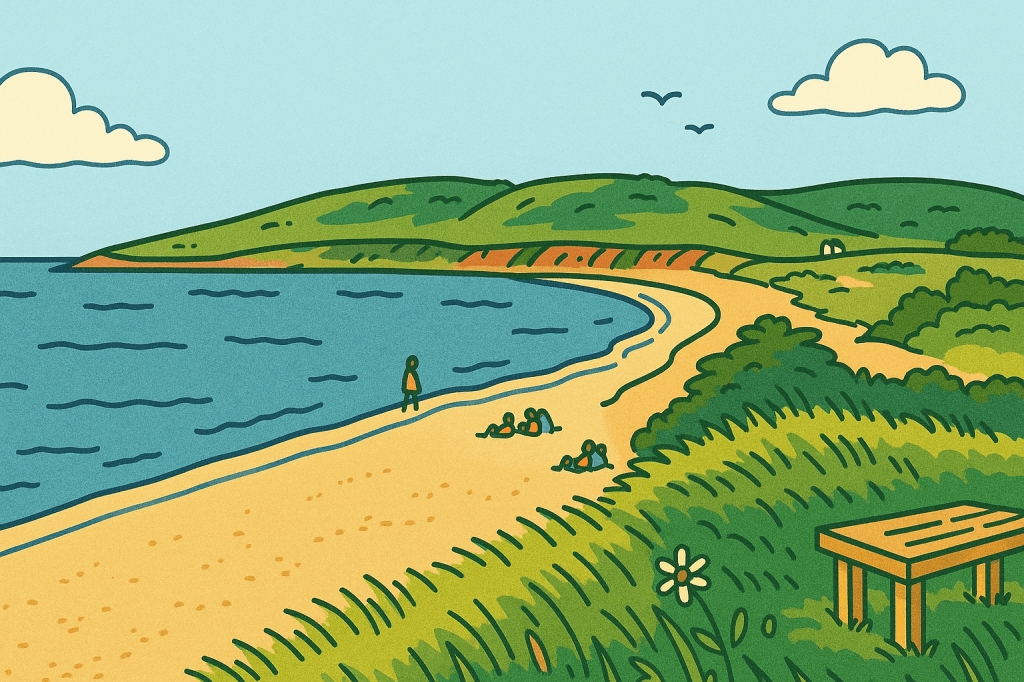
A gull screamed above the dunes, its wings catching the late-afternoon light like a flash of polished bone. The tide was out, and West Mabou Beach sprawled in wide bands of sea-glossed sand, shallow water shimmering like glass under a pale sun. The wind—cold, sharp, straight off the Gulf—rattled the faded wooden sign nailed to a post near the lot: Provincial Park – No Vehicles Beyond This Point.
Isla Beaton walked barefoot, boots tied and slung over one shoulder, pants rolled to her calves, a thick hoodie drawn up over her black hair. Her jeans were already crusted in dried salt from a creek she’d crossed upstream, chasing silence. No earbuds today. The beach didn’t need a soundtrack.
About a half kilometre down, near the low cliffs where dogwood tangled with spruce, she noticed them.
Two men. Not tourists.
One was hunched over a tripod-mounted instrument pointed inland, adjusting knobs with careful precision. The other stood off to the side with a clipboard, watching something invisible—marking, measuring. Surveyor types, maybe. But they didn’t look provincial.
They wore clean windbreakers, spotless boots. One had a Cape Golf-branded ballcap. The other’s truck—a black Yukon—was parked illegally just inside the old gate, beside the worn “No Motorized Access” sign. No one ever parked there, not in April.
She slowed.
The clipboard guy noticed her. Gave a small, two-finger wave. The other didn’t.
They didn’t call out. Didn’t offer an explanation. Just turned back to their instruments and notes.
She stared for a moment longer, then kept walking, past the curve of sand, past the tide pools filling slowly with sky.
Something itched in her chest. Not anger—yet—but something ancestral. Some whisper that this place, this crooked bay with its seaweed tang and rattling driftwood and old birdsong, didn’t belong to men with clipboards.
She’d ask her dad. He knew things. Even if he never wanted to talk about any of it.
The bell over the shop door gave its familiar defeated jingle as Isla stepped into Beaton & Son Hardware, even though the “& Son” part hadn’t been updated since before she was born. Her father stood behind the counter with a half-unwrapped roll of polyethylene under one arm and a calculator in his other hand.
He looked up. “Thought you were off communing with sea spirits.”
“I was,” Isla said, brushing sand off her knees. “Until I found guys creeping around the park.”
Callum’s hands didn’t stop moving. “What guys?”
“Two of them. Big Yukon parked right next to the no-vehicles sign. One had a Cape hat.”
That slowed him. He set the plastic roll down and leaned forward slightly.
“Cape?” he repeated.
She nodded, peeling off her hoodie. “They had a tripod. Measuring gear. Surveying, I think.”
He scratched his jaw, eyes drifting toward the window where the wind pressed dry leaves against the glass.
“Probably just developers sniffing around,” he muttered. “Happens every few years.”
“They were in the park, Dad. That’s protected land.”
Callum didn’t answer right away. He turned, fiddled with the receipt printer, then walked behind the counter to unplug the coffee machine. His silence was deliberate, practiced. Isla had seen it before—after the funeral, during COVID, whenever something big loomed.
She stepped closer. “Do you think it’s true? That they’re going to build another course?”
He gave a dry snort. “They already got two. Think they’ll stop now?”
She frowned. “This is different. It’s a park.”
“That never stopped anyone,” he said, too softly.
The silence that followed wasn’t comfortable.
“You’re not going to say anything?” she asked. “To anyone?”
Callum looked up at her, then past her, toward the front door where the wind now pushed harder, rattling the frame. The last light of day was slipping off the wet pavement.
He pulled the keys from his back pocket and started toward the entrance. “Not until I know what I’m talking about.”
She stood there as he turned the lock.
“Go wash your feet,” he said over his shoulder. “You’re tracking in half the beach.”
The kitchen smelled like haddock fried in too much butter. A green curtain danced over the open window, letting in sea air and a faint sour whiff of kelp. Callum moved slowly between stovetop and sink, bare feet heavy on the worn linoleum, his shoulders curved like a bridge under strain.
“Plate,” he said.
Isla passed him one. He scraped two filets onto it with a metal spatula, then slid it across the counter. “Fork’s in the drawer. Rice in the pot.”
She grabbed what she needed and sat. No one spoke for the first few minutes. They rarely did. The television in the living room murmured low—some panel of Toronto types arguing about pensions.
Outside, wind pulled at the siding.
“Why’d they make it a park?” Isla asked finally, between bites. “Do you remember?”
Callum didn’t look up. He was picking at the second filet with surgeon-like care. “Back in the nineties. Some folks petitioned. Environmental protection. That sort of thing.”
“Angus Campbell was part of that, right?”
“Probably. He’s been part of everything.”
She pushed her rice around the plate. “Do you think it matters? That it’s a provincial park?”
“I think,” he said slowly, “it matters to people who care. But not everyone does.”
She stared at him. “But legally. Doesn’t it stop them?”
Callum shrugged. “Depends who’s in charge.”
Isla exhaled sharply. “So they can just… undeclare it?”
“It’s not a magic spell, Isla. It’s politics. Cabinet decisions, mostly.”
She stood, suddenly restless, and paced to the window. A car passed outside, tires humming on damp pavement.
“I’m going to post about it,” she said. “That I saw them. That they were surveying.”
Callum didn’t move.
“I might start a petition,” she added. “Or at least ask around. People need to know.”
He set down his fork. “Careful.”
“Careful of what?”
“Starting fires you can’t put out.”
She turned. “You mean doing something?”
“I mean blowing up your whole world on the word of two guys with a tripod and a Cape hat.”
“They were in the park, Dad.”
Callum stood up slowly and took his plate to the sink. “And maybe they were just looking. Maybe it’s already a done deal. You don’t know.”
“But we can know. If people push—if we organize—”
“No,” he said firmly, turning to face her. “You push too fast, too loud, they’ll box you in, call you hysterical, and nobody listens. That’s how this works.”
The silence that followed wasn’t empty. It was electric.
“Sounds like fear,” she said, voice low.
Callum looked at her for a long moment.
“It is,” he said.
The folding chairs in Mabou Hall hadn’t been replaced since the sixties, and the heating system made a sound like a moose dying under a tarp. Still, people came. They always did when something threatened to change things.
By 6:45, the parking lot was packed—F-150s, rust-bitten Civics, a few battered Subarus. Isla sat near the front, notebook in her lap, scanning the crowd. She saw Angus Campbell near the back, arms crossed, cap low. Sadie MacNeil stood by the coffee urn, listening intently to Derek, who gestured with a half-eaten oatmeal cookie like it was a baton.
Her father sat on the far edge of the row behind her. Close enough to observe, far enough not to be implicated.
At exactly 7:00, the front doors opened again, and Graham Schizer entered like he owned the place.
He had the look of someone used to microphones—smooth blazer, tan complexion, steel-grey hair parted with a ruler. A Cape-branded folder in one hand. Not a scrap of paper out of place.
“Good evening,” he said, striding up to the mic stand. “What a pleasure to be back in Mabou.”
Some clapped. Some didn’t.
He smiled wide, revealing investment-grade teeth. “I know there’s been chatter. Rumours. Concerns. And I think it’s important we meet face-to-face, neighbour to neighbour, and talk about what’s really happening.”
Isla’s stomach twisted. She felt Callum’s presence behind her like a stone.
Graham flipped open his folder. “The Cape group is exploring the idea of a new, world-class course that would highlight the natural beauty of West Mabou. We believe golf can coexist with conservation—and enhance public access, not restrict it.”
Someone near the back coughed. Loudly.
Graham pressed on. “This is not a done deal. We’re early in the process. But we wanted to begin with consultation, transparency, and—above all—respect.”
Murmurs rippled through the crowd. Sadie raised her hand.
“Yes,” Graham said, pointing.
“If it’s not a done deal,” Sadie said, “why were there surveyors in the park last week?”
A pause. Just long enough.
“We routinely send folks to assess feasibility,” he said. “That doesn’t imply commitment. It’s just good planning.”
Isla stood.
“Who gave them permission to go into a protected park?”
Heads turned.
Graham smiled like he’d expected this. “The Department of Natural Resources was informed. We followed protocols.”
“What protocols?” Isla asked. “The ones where you get what you want because you’re rich?”
A few gasps. A few nods.
“I’d be happy to meet with you afterward,” Graham said smoothly. “There’s no need to make this personal.”
“It is personal,” came a voice from the back.
Angus Campbell stepped forward. His boots thudded on the old floor.
“That park belongs to the people of this province,” he said. “It’s not your brochure. It’s not your playground for men in slacks.”
Several clapped. Someone hissed.
“You paved Inverness and called it progress,” Angus continued. “Now you want to carve up another corner of coast. For what? So somebody from Dallas can post a picture of their lobster roll?”
Graham held up a hand. “Let’s be respectful—”
“Respect is earned,” Angus snapped.
The hall buzzed, loud now. Two men near the middle row stood up, one shaking his head, muttering, “This is why nobody invests in places like this.”
Callum still hadn’t moved.
Isla turned slightly, met his eyes—just for a moment.
He looked away.
The post hit Facebook before Isla even got home.
A shaky clip of Graham Schizer’s smug grin as he said, “Golf can enhance public access.” The audio was clear. The sarcasm in her caption was sharper:
Isn’t it so generous when billionaires offer to improve something they’re about to destroy? #WestMabouNotForSale
By morning, it had over 130 shares. By noon, it had a tag war in the comments—names Isla recognized from church, the school board, the meat counter at the Co-op.
Sadie MacNeil:
Folks, maybe let’s all take a breath. Nobody’s tearing anything down yet.
Derek MacIsaac (replying to Sadie):
Maybe YOU can afford to wait. Some of us need the work.
Rory Gillis:
So we sell our coast for what, six dishwashing jobs and a fresh layer of turf?
Nancy Campbell (Angus’s cousin):
My grandkids might finally be able to stay here if we had real jobs. Angus has his pension. What do the rest of us have?
By dinnertime, someone had created a second group:
“Mabou Deserves Better – Jobs and Progress”
Banner image: golfers smiling on the cliffs of Inverness.
Founding admin: Derek.
The café was louder than usual that afternoon. Not in sound—no one was talking—but in tension.
Sadie moved like someone carrying a full glass of water over ice. Three tables had customers who hadn’t looked up once. One regular—Mrs. Rankin, who always left a tip in exact change—sat with her arms folded, eyes locked on her untouched muffin.
When Isla walked in, conversation died completely.
Sadie greeted her anyway. “Want your usual?”
Isla hesitated. “You still talking to me?”
Sadie smiled thinly. “I talk to everybody. It’s my job.”
She poured a coffee, set it down with practiced ease.
“I saw the comments,” she added.
“I meant what I said.”
“I know you did.”
They stood in silence.
Then, quietly, Sadie asked, “Can I tell you something without you posting about it?”
Isla nodded.
“There’s good people who support the course,” Sadie said. “That doesn’t make them evil.”
“Doesn’t make them right either.”
Sadie leaned in, eyes tired. “You think I want this? I’m still paying off my CEBA loan. I haven’t hired anyone full-time in three years. What am I supposed to do—fight the only people bringing money in?”
“Maybe.”
Sadie looked down, then smiled softly. “You sound like your mother.”
The words hit like salt on a fresh scrape.
Isla picked up her coffee, gave a nod, and left.
At the hardware store, Callum saw it too. A change. People still came in, but the small talk died. Neighbours who once spent ten minutes chatting over paint chips now left with mumbled thanks.
Two men nearly argued over propane fittings.
One asked if Callum was “part of that protest nonsense his daughter was stirring up.”
He didn’t answer. Just rang them through and kept his head down.
That night, Angus stopped by, just before close.
He bought rope and gloves. Refused a bag.
“Hell of a speech you didn’t give,” Angus muttered.
Callum paused. “Wasn’t my place.”
“Your girl’s doing what you should’ve.”
Then he left without saying goodbye.
The BMW was spotless except for the plastic grocery bag squatting dead center on the hood. It had been tied twice, but not tightly. Enough to keep the shape. Enough to suggest deliberate placement.
Schizer stood in the gravel driveway with his phone held high, angling for the best shot.
Close-up. Then wide.
In the background, his rented bungalow sat bland and neutral. A polite little executive getaway two kilometres outside Port Hood, tastefully staged with “Live, Laugh, Love” beach signs and a bowl of decorative rope on the table.
His caption read:
“I believe in dialogue. In conversation. In building better futures. But this is what some in Mabou think passes for debate. Disgusting, cowardly, and sad. #WeCanDoBetter”
Then he carefully, with gloves on, removed the bag of dog shit from his car and into a thicker garbage bag and brought it to the box at the end of the driveway.
Within an hour, his post was retweeted dozens of time, including by a cabinet minister.
At 4:17 that same afternoon, the Province of Nova Scotia issued a four-sentence news release:
Effective immediately, the status of West Mabou Beach Provincial Park is being re-evaluated under the Parks and Protected Areas Plan. The area will be reclassified to allow for alternative recreational development in alignment with regional economic goals. Further consultations will be announced in due course.
No press conference.
No Q&A.
No mention of golf.
The media barely noticed. Halifax was mid-scandal with a ferry tender gone sideways.
But in Mabou, someone printed the release and taped it to the Co-op freezer with a butcher knife.
The café was full when the news hit.
Sadie read it on her phone behind the counter and froze mid-pour. Across the room, Derek was nodding along with a man in a golf windbreaker—someone no one quite recognized.
Angus walked in five minutes later, holding the printed release like it was a death notice.
He slammed it on the counter. “That’s it.”
Sadie looked up, stunned. “You’re sure?”
“It’s over. They’ve got what they wanted.”
A man at the back stood. “You don’t know that.”
Angus spun to face him. “Are you blind or just stupid?”
Derek stood too. “Angus—”
“Don’t talk to me.”
“Then don’t talk at me.”
“Thirty years ago we protected that beach,” Angus growled. “We marched for it. Lobbied. Met with the ministers. I was there. You were still in your father’s skidoo trailer.”
People stopped eating.
Sadie moved to the front. “Okay. Enough.”
“I’ve got enough,” Angus snapped. “Enough lies. Enough deals made in f—”
Something crashed.
A chair.
Thrown. No one saw by who.
It hit the linoleum and bounced with a thud and scrape and fell flat.
Silence. Breathless.
Sadie’s face drained.
Callum was outside when it happened. He’d come to return a propane tank someone had left at the shop.
He heard the sound through the wall. Watched as Angus stormed out, shoulders shaking, eyes raw.
Isla followed seconds later, clutching her phone.
“Did you see it?” she asked.
Callum nodded.
“Do something,” she whispered.
He opened his mouth.
But said nothing.
The fences came fast.
One day the dirt access road to the beach was muddy and half-eaten by ruts, and the next, it was ringed with bright orange mesh and two new “NO TRESPASSING – SITE PREPARATION UNDERWAY” signs, hammered into the earth like exclamation marks.
Then came the posts—tall, grey, driven deep. Steel fencing was fastened along the top of the dunes in sections, curving around the western path that locals used to take from the tree line. A new gravel lot was being shaped out of what used to be a wildflower meadow.
And just beyond it all, at the edge of the beach, parked on the gravel: a white pickup with a vinyl security badge across the door and a man sitting behind the wheel eating a ham sandwich.
Isla was there before school.
She’d biked the seven kilometres from Mabou with gloves on, teeth chattering, camera bag strapped to her back. When she reached the fence line, she got off and walked slowly to the gate. It was chained shut.
The metal was cold beneath her fingers.
She could see the sea, still there, endless, laughing at the notion of gates. But now the sand was fenced. The old driftwood log she and her mom used to sit on was gone—probably bulldozed with the stunted trees.
She stood there, not moving, for a long time.
Then her father’s truck pulled up.
He got out slowly, as if preparing for weather.
She didn’t look at him.
Callum walked to her side, hands in his coat pockets.
For a few seconds, they stood in silence, the fence between them and the life they remembered.
Then she said, “They said we’d always have access.”
Callum didn’t reply.
“They promised.”
“Marketing always sounds like promises,” he said quietly.
She turned to him, eyes red. “This is my place.”
He nodded.
She shook her head. “You just let it happen.”
“I didn’t let it—”
“You didn’t stop it,” she snapped. “You watched it happen. You stood there while Schizer lied, while people yelled, while the signs came down, while—” Her voice cracked.
“I’m not the one building the course, Isla.”
“But you’re the one who could’ve said something when it still mattered.”
He inhaled sharply. “I didn’t want to lose this town.”
“We lost it anyway,” she said.
That stopped him.
The wind picked up. The fence creaked. Out beyond it, gulls wheeled and screamed over the water like they’d always done.
She looked back at the beach once more, then stepped away from the gate.
When she walked past him, she didn’t look up.
He didn’t stop her.
______________________________________________________________________________
The sky hadn’t yet figured out what it wanted—half silver, half gunmetal, with the moon still clinging to the western horizon when Isla dropped her bike behind a salt-blistered spruce and crouched beside the gravel lane.
She checked her phone. 5:48 a.m.
The others were already there—Maddie, Liam, two others she barely knew from school. One wore a Guy Fawkes mask. Another had a GoPro strapped to his chest. It felt performative, but Isla said nothing. Everyone needed something to hold on to.
They waited in silence.
At 6:02, headlights crested the rise.
A white half-ton pickup rolled slowly toward the gate, followed by a flatbed hauling portable toilets and a small excavator. Two more trucks behind that.
Isla stepped out.
No vest. No signs. Just a camera phone in one hand and her mother’s scarf wrapped tight around her neck.
She stood square in front of the first truck.
The others followed, forming a loose semicircle.
The truck honked once—short, annoyed. The driver rolled down the window.
“You kids need to move.”
Isla raised her phone.
“We’re here to protect public land.”
“Not your land,” he said.
“Not yours either.”
By 6:11, the livestream had seventy-six viewers.
By 6:17, RCMP officers arrived.
By 6:22, an officer in a yellow vest asked her twice to move.
She said no.
“Last warning.”
“No,” she said again, louder.
Angus arrived five minutes later, his breath visible in the cold. He stood behind the kids, silent, arms folded like granite.
Another officer moved in. Then another.
They took Isla first.
Not roughly, but not gently either—arms behind her back, cuffed, led to the cruiser.
Her livestream kept rolling on Maddie’s phone.
The footage was up for twelve minutes before Facebook pulled the audio for copyright.
But by then, it had already been ripped, shared, mirrored.
“Teen Arrested for Blocking Access to Protected Beach”
“RCMP Arrest Local Girl Fighting Golf Course Giants”
“The Cost of Speaking Up in Nova Scotia”
In Mabou, the café was packed by 9 a.m.
Sadie stood behind the counter, watching the video on repeat, her jaw clenched.
Derek refused to look. “It’s not like she’s in jail.”
“She’s sixteen,” Sadie snapped.
“She broke the law.”
“So did they.”
Callum sat in his truck outside Rankin’s constituency office, radio off, phone buzzing in his lap. He hadn’t called Isla yet. He knew she was fine—had seen her in the background of someone’s Instagram story, arms crossed, arguing with an officer like it was a school debate.
But still.
A sign had been taped to the MLA’s door:
Office closed due to threats. No walk-ins. By appointment only.
He sat there for a long time, watching people slow down as they passed.
No one looked at each other anymore.
Everyone looked at the ground.
The church bell rang just once.
It echoed out across the cemetery ridge, down over the river, and into the bones of Mabou like it always had. Old-timers said the bell had been cast in Boston and shipped in by boat before the roads even reached this far.
Now, it tolled for Mary Ann Gillis, age 82, who had lived in the same white house above the Co-op for six decades and made shortbread for the fire department every Christmas. She had no part in the debate, no skin in the game, no children left in town. And still, the whole village came.
Because that’s what you did. Or used to do.
The pews were full—but fragmented. Families that had always sat together now took opposite aisles. Callum noticed it immediately. The Campbells were spread out, some pretending not to notice the MacIsaacs two rows up. Sadie sat alone, lips pressed tight, hands clasped so hard her knuckles shone.
The priest’s eulogy was short, efficient, non-political.
No one lingered at the end.
The usual post-funeral reception had been cancelled. “Mary Ann would’ve understood,” someone muttered.
Outside, people lit cigarettes like it was instinct. No one hugged. The wind did most of the talking.
Callum found Sadie near the church steps, shoulders hunched beneath her coat. She looked thinner. Less rooted.
He nodded. “Sorry about earlier. I saw Derek’s post.”
She exhaled. “He’s blocked me now. Said I ‘choose drama over family.’” She laughed bitterly. “He works in Truro now. Wasn’t even here when they locked the gate.”
Callum offered a cigarette. She took it without thanks.
They smoked in silence.
Then she said, “You ever think maybe this is just what happens? Eventually?”
“What?”
“That places like this… just run out of story.”
He watched a hawk turn slowly over the trees, floating.
“Don’t know,” he said. “Stories usually end with someone winning.”
She looked at him sideways. “You think they’ve won?”
He didn’t answer.
She dropped the cigarette, crushed it under her boot. “I used to love running this place. The café. The people. But now I can’t stand hearing any of them talk.”
Callum nodded. “I keep the radio on at the store. Pretend I’m busy in the back.”
The wind shifted, carrying the smell of salt and wet pine.
Sadie turned to leave, but paused. “You still talk to Isla?”
“Barely,” he said.
Then, after a beat, “She’s got more courage than I ever did.”
Sadie gave him a look. A tired, grateful one.
Then she walked away.
And Callum stood there, watching the last few people trickle toward their cars, not speaking, not looking, not even pretending anymore.
______________________________________________________________________________
The ribbon was green.
Not symbolic green, not forest green—bright plastic turf green, stretched between two polished cedar posts hammered into a dune that had stood untouched for a thousand years.
The wind did not cooperate. It tugged at the cheap nylon banner with a kind of grim satisfaction. The Premier squinted against the gusts, hair lacquered into submission, flanked by smiling Cape executives in navy windbreakers and expensive sunglasses.
A half dozen local children—recruited from a nearby school with the promise of a field trip—stood awkwardly beside a cartoonish cardboard cutout of a lobster swinging a golf club.
There were speeches. Brief, practiced, free of meaning.
“A balance between progress and preservation.”
“Economic revitalization for all of Inverness County.”
“A proud moment for Nova Scotia.”
Camera flashes. Applause from those holding golf umbrellas with the Cape logo.
What wasn’t photographed: the line of police cruisers parked at the old trailhead; the barricades set up halfway down the gravel road; the twenty or so protesters—including Angus, in his old yellow raincoat—trapped behind a designated “Free Speech Zone” that had been roped off like a livestock pen.
Isla didn’t stand with them.
She watched from higher up, hidden in the tree line, lying on her stomach with binoculars pressed to her face. Her phone was off. No more streams. No more shares. That hadn’t helped.
The section of beach still “open to the public” was barely a corridor—fifty feet of soft sand behind the toilets, flanked by signage that listed rules in fine print: no dogs, no bikes, no fires, no noise, no drones, no lingering.
No Parking anywhere near the trailhead. Violators would be towed.
A seasonal access shuttle was promised but hadn’t materialized.
She could see the new clubhouse already taking shape—a modern glass box with cedar accents and a wraparound deck. A boardroom with a sea view. A resort that could sleep thirty, with private chefs flown in from Toronto.
From up here, the old curve of the beach was almost unrecognizable. The dunes were lowered, shaped. Sculpted for the first tee.
A man with a drone controller stepped out onto the balcony, launched it with a flick of his wrist. It hummed upward, blinking red.
She backed deeper into the trees.
Callum drove by half an hour later. He didn’t park. He didn’t roll down the window. He just slowed as he passed the chain-link gate, saw the crowd behind the press barriers, the security men in earpieces, the giant logoed flag snapping in the wind.
He looked once at the path that used to lead to where Isla and her mother once picnicked.
Then he kept driving.
The road curved.
The view disappeared.
By July, the signs were up on every utility pole from Inverness to Port Hood:
“CAPE SHORES – NOW HIRING SEASONAL STAFF”
Golf Course Ambassadors. Food Service. Turf Assistants. Competitive Wages.
The “competitive” turned out to be $16.25 an hour, with no benefits and shifts posted a day in advance via an app that barely worked when the cell tower hiccupped in fog.
High schoolers filled out applications in Sadie’s café between sips of Pepsi and low-grade panic. Isla’s former classmates posted photos in beige polos and name tags with forced smiles under banners reading #WestMabouStrong.
Isla didn’t apply.
She worked mornings shelving books at the library in Port Hood. The librarian never asked about the arrest. Never said much of anything. Which suited Isla fine.
Derek did apply.
He got hired on a landscaping crew with a subcontractor from Antigonish. Four weeks in, the contract ended suddenly. He was told someone else had underbid. His last paycheck bounced once before clearing.
He didn’t come into the café for three days.
When he did, he looked tired and twenty years older.
Sadie brought his toast without asking.
“I thought you were part of the progress,” she said.
He didn’t answer.
Angus stood in the post office reading a flyer about “Community Information Sessions for Coastal Integration.” He laughed out loud. The clerk asked if he needed help.
“No,” he said. “They already helped themselves.”
At the hardware store, Callum sold golf tees now.
A vendor had left a small countertop display—“just to try”—and they were selling better than hammers.
He kept his head down and his receipts in order.
One morning, a customer asked if he knew where to get sandbags for a landscaping project near the new clubhouse. Callum gave directions, added a 15% markup without thinking, then knocked it back down.
He wasn’t proud of the sale. But he wasn’t proud of anything lately.
One afternoon in August, Sadie stepped outside her café and stood with her arms crossed, watching a shuttle van zip past on its way to the course.
It was filled with tourists from Michigan, or Florida, or Ontario. Hard to tell. They all wore the same windbreakers.
Her son, Jamie, sat in the back, earbuds in, name tag shining under the tinted glass.
She waved.
He didn’t see her.
“Trickle down,” she muttered. “Forgot to bring a damn cup.”
The wind had softened over the years, but not the silence.
Mabou was quieter now. Not abandoned—just dimmed. Like someone had turned the dial down on conversation and left it there.
The West Mabou course operated like clockwork: drones mapping every hole each morning, imported turf experts walking the greens, a fleet of carts humming down sculpted paths like luxury beetles. The early investors were satisfied. The resort’s bookings were solid. The restaurant now offered “foraged sea greens” on a fixed tasting menu for $110.
Locals still came near the shore—technically, legally, in the same narrow corridor—but they stopped calling it the beach. It had another name now. A branded one. It was easier that way.
Isla visited only once more.
She walked the thin path with a camera around her neck and no batteries in it. Just to see. Just to remember.
Security watched from a distance but didn’t stop her.
She stayed for six minutes. Then left.
The old protest page was a ghost town—just links to news stories, years old, and photos of people no one remembered clearly anymore. Angus still showed up sometimes, standing just beyond the gate in a coat older than the course, holding a laminated sign: “This is stolen.”
They ignored him. Or worse—offered him coffee from the clubhouse in a paper cup with the Cape logo.
Sometimes, he accepted. Sometimes, he threw it into the grass.
He was arrested three more times. Always released. Always back the next weekend.
Epilogue
A conference room in Halifax. Glass table. Sleek chairs. Bottled water with labels that cost more than a Mabou lunch.
Three men in golf shirts, sport jackets over top, were mid-presentation.
One stood near a map. Another scrolled through a deck of slides: “Expansion Opportunities – Gulf Coast North.”
Schizer sat back, ankles crossed, fingers laced.
“This one’s promising,” the presenter said. “Good elevation. South-facing curve. Closest airport’s two hours, but the views…”
He clicked.
An aerial shot filled the screen—long, uninterrupted sand curling gently into blue. The words beneath: Port Hood Beach – Preliminary Viability
Schizer smiled faintly.
“Very nice beach,” he said. “Very nice.”
 Community From Within